This exhibition is the result of a collaboration among mischer’traxler studio, the Naturmuseum Südtirol, and the Embodied Data Lab. The exhibition invites visitors to explore what has been lost, what remains, and what is changing in the regional flora and fauna. We focused on biodiversity loss because it is a critical environmental issue that is difficult to communicate, as its effects are not visible within one lifetime, a phenomenon known as the “shifting baseline syndrome.”
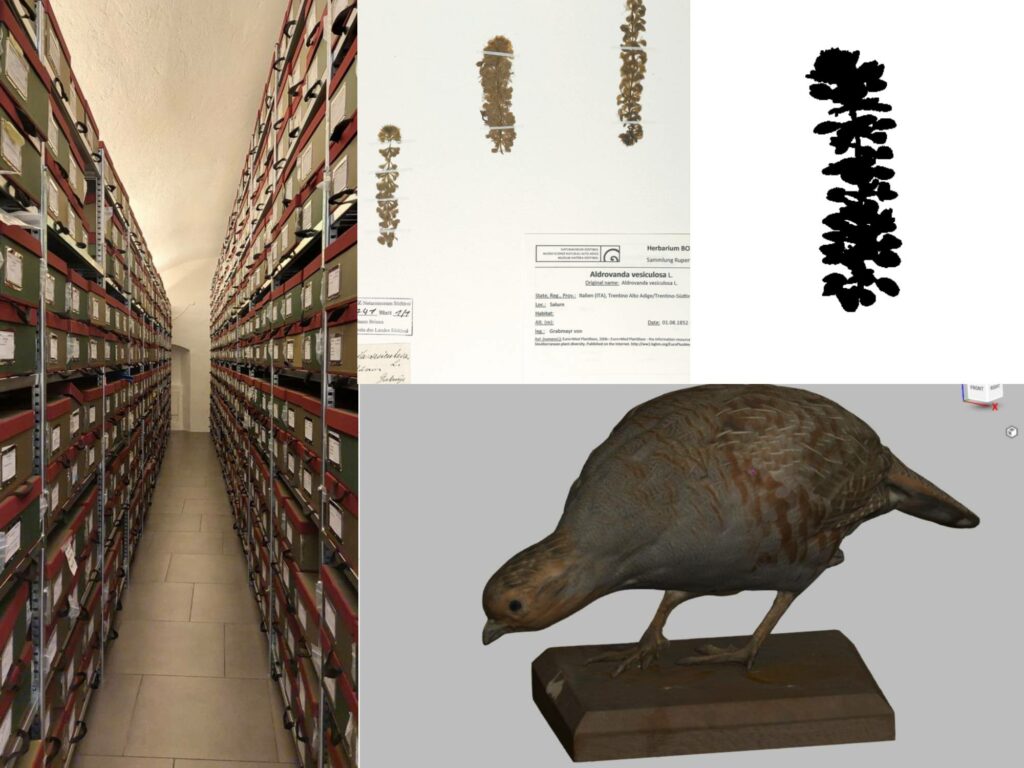
Starting from the archive of the Naturmuseum of Bolzano, key extinct and endangered animals and plants in South Tyrol have been identified together with Petra Kranebitter (zoologist) and Thomas Wilhalm (botanist), both researchers at the Naturmusem. These have been digitised using 3D-scans and photogrammetry skills and tools available at the EARTH_LAB (Laboratory for Digital Environment for Education, ART and Heritage; Faculty of Education) and 3D printers at the Prototyping Lab of the Faculty of Engineering. AI models helped reconstruct fragile specimens such as plants and butterflies.
These data, together with nearly 100 photographs of other key species from the archive, provide the ground for the interactive exhibition development and evaluation as an artefact about the territory. By situating this exhibition within a museum, we create a space for dialogue among locals and tourists, aligned with the work at the Faculty of Economics, allowing visitors to engage with narratives that cultivate sensitivities and foster a collective responsibility towards natural heritage.
The resulting exhibition, conceptualised and developed by mischer’traxler studio, deals with topics of extinction, trivialisation, and neobiota.
Visitors can interact with extinct species using Augmented Reality (AR), an engaging yet uncanny experience, as digital interfaces are now the only way we can interact with them in South Tyrol. An interactive installation brings these topics together and invites people to experience biodiversity change in South Tyrol from 1850 to 2050.
The seven-meter-long installation consists of eight depth cameras for motion tracking, a computer, speakers, and two projectors. When visitors enter the space, their silhouettes are projected onto the screen and filled with images of animals and plants from 1850. As they move along the timeline, the visual content changes, removing the species that have gone extinct in the region. By 2050, visitors can see their silhouettes composed of fewer and more similar species, representing biodiversity loss and species trivialisation.
A key aspect of the installation is the evaluation of meaningful experiences with interactive technologies. Performance and enjoyment have been key quality metrics to measure the interaction with digital technologies; however, as societies and technologies increasingly shape each other, there is a need to focus not only on efficiency or fun but also on the significance of interactions.
We will assess how people experience the installation through conversations and postcards that participants can send to their future selves. These data will be used solely for research purposes and will be treated in accordance with the EU’s General Data Protection Regulation. For information on GDPR data privacy, please check the privacy policy for the discussions, and postcards.
Echoed Nature – Credits
Principal Investigator (PI):
María Menéndez-Blanco, unibz
Interactive installation:
mischer’traxler studio mit Marlen Jachek, Simon Laburda (DKIA)
Scientific support, archive selection and preparation:
Petra Kranebitter, Thomas Wilhalm, Naturmuseum Südtirol
Artistic direction and exhibition design:
Katharina Mischer und Thomas Traxler, mischer’traxler studio
Scientific Assessment:
María Menéndez-Blanco, Giulia Grillini, Niccolò Pretto, unibz
3D scanning und AR:
Giuseppe Nicastro, Francesca Condorelli, unibz
Filming and editing:
Matteo Vegetti, unibz
Made possible by:
iNEST, unibz, Naturmuseum Südtirol. This installation would not have been possible without the work and skills of the lab technicians at the Faculty of Engineering and the Faculty of Design and Art